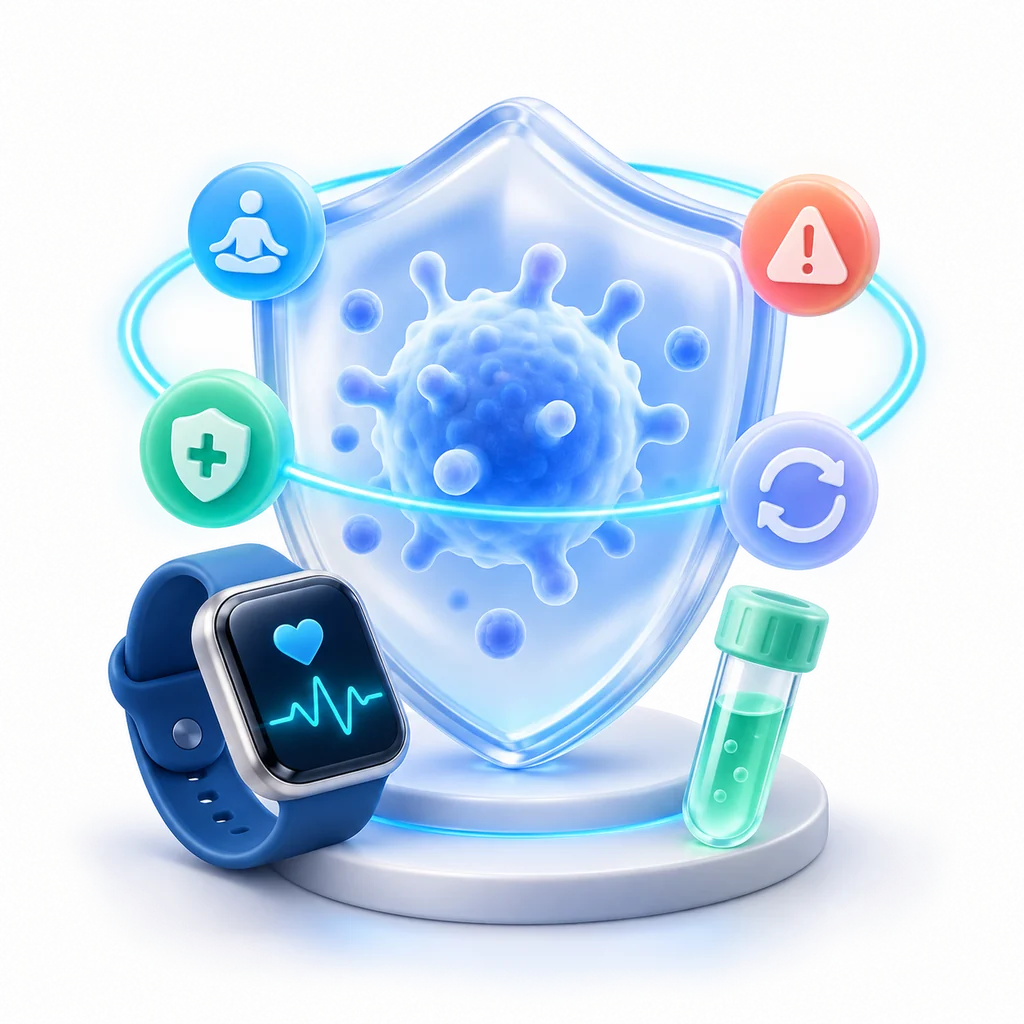
A cold rarely comes out of nowhere. A day or two before, a watch usually picks up a higher resting heart rate, lower heart rate variability (HRV) and a slightly warmer night. After an illness, the same signals tell you whether you have really recovered or just got past the fever. Anpheros Daily reads these signals next to your lab results, symptoms and medication, and shows you, simply, which state you are in.
Lab results
CRP, ESR, neutrophil-to-lymphocyte ratio, vitamin D, zinc, ferritin, each placed on its range.
Overnight signals
Resting heart rate, HRV, temperature, breathing and sleep, compared with your own 30-night average.
Symptoms and recovery
Episodes of illness, how long they lasted and how many days it took to bounce back.
The four states
Instead of a score, the app shows one of four states on a wheel:
- Balance: your signals are at your average, nothing is out of pattern.
- Vulnerability: something has been off for two nights in a row, such as a resting heart rate a few beats above your average or an HRV well below it. A good moment to sleep more and skip the hard workout.
- Acute response: you have symptoms of infection, a fever, or you are taking a fever reducer or an antibiotic.
- Convalescence: the illness is over but your body is still recovering. The app counts the days until your signals return to your average.
Under the wheel, the "Your defence capacity" bar shows how much reserve you have right now, without numbers, along with what lowers it (short nights, alcohol from the meals you photographed, a recent vaccination, a high CRP) and what supports it (good sleep, enough protein, the supplements you took).
Where the data comes from
You don't fill in anything extra. The screen uses what is already in your record:
- lab results scanned from your reports;
- your watch, through Apple Health or Health Connect: resting heart rate, HRV, wrist temperature, breathing rate, oxygen saturation and sleep;
- symptoms from your journal, with their intensity;
- medication: a fever reducer can hide a fever, and a finished antibiotic usually means two more weeks of recovery;
- one short question a day, if you like, about how you feel.
The thresholds also take the menstrual cycle into account: in the second half of the cycle temperature and heart rate rise naturally, and the app does not mistake that for illness.
Who it helps
- People who get sick often and want to see the pattern across the year.
- Athletes who want to know when not to push.
- People recovering from a virus, flu or COVID who wonder whether the tiredness is normal.
- Parents, for each child in the family record (watch signals for the account holder only).
Getting started
- Install the app and create an account.
- Connect your watch through Apple Health or Health Connect.
- Open "Immune system" from "Explore". The first signals appear after a few nights, once the app knows your average.
The "Immune system" screen is included in the Plus and Max plans. Plus comes with a 7-day trial, no card required.
Frequently asked questions
Is this a diagnosis?
No. The app shows patterns in your data; it does not diagnose and does not replace your doctor. If you have a high fever, trouble breathing or feel unwell, call your doctor or your local emergency number.
Why is there no immunity score?
Because no single number measures a person's immunity accurately. A state described in words, with the reasons next to it, is more honest than "73 out of 100".
Does it work without a watch?
Yes, with lab results, symptoms and medication. With a watch, the app sees the signals a day or two earlier.
What happens to my data?
It is stored in the European Union, in the standard HL7 FHIR format, and it belongs to you. No ads and no selling of data.