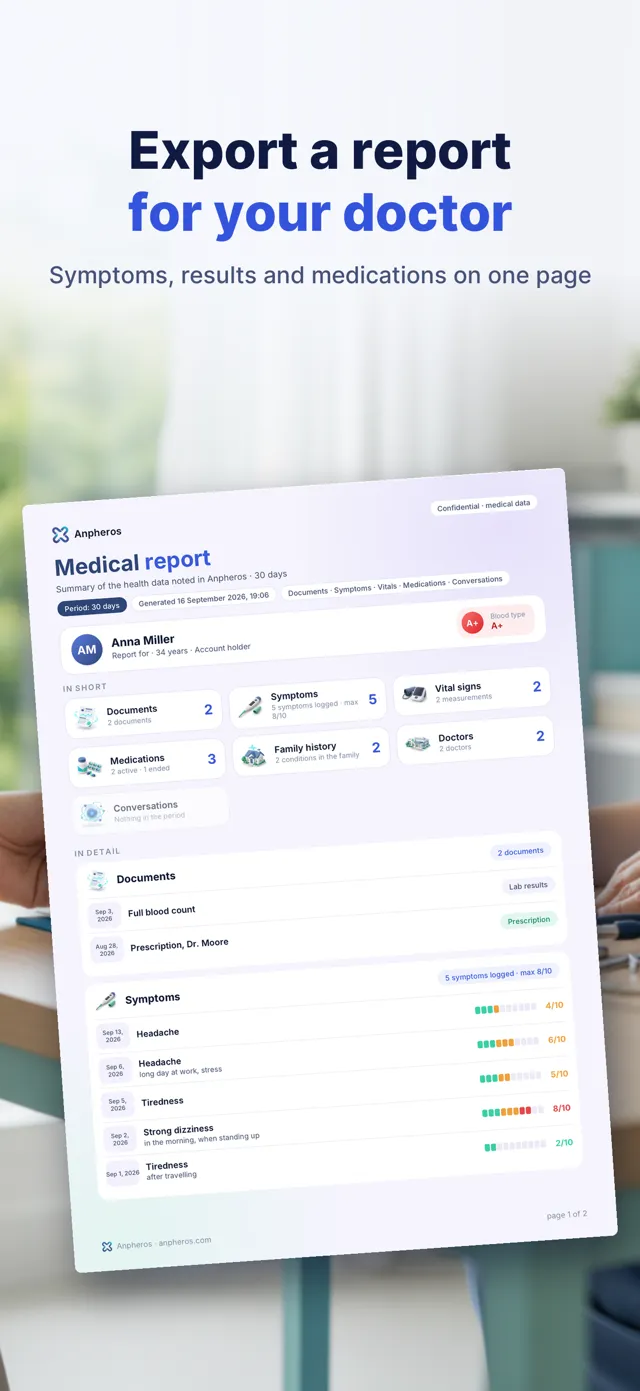
Short answer: a doctor-ready summary fits on one page and answers, in this order: why you are here (one sentence), current problems, medicines with doses, allergies, recent results with their trend, a dated timeline of the symptom, and your three questions. It leaves out what the doctor already has and anything older that does not change today's decision. You can make it free with the appointment checklist and the symptom timeline; an app such as Anpheros Daily builds it from your record and shares it as a PDF or a link that expires.

At a glance
| Length | One page, readable in a minute |
|---|---|
| Order | Reason → problems → medicines → allergies → results → timeline → questions |
| Medicines | Active substance, dose, how often, since when; include supplements |
| Results | The last values with dates and units, and the trend |
| Free templates | Appointment checklist, symptom timeline, lab results tracker |
| Standard format | The International Patient Summary (IPS), readable by other systems |
What goes on the page
- Why I am here, in one sentence. "Headaches three mornings a week since September, worse in the last fortnight."
- Current problems. Long-term conditions and anything active, with the year they started.
- Medicines. Active substance, dose, how often, since when, and why. Include over-the-counter medicines and supplements; stopped medicines only if recent.
- Allergies and reactions. The substance and what happened.
- Recent results. The values that matter for today, with date and unit, and how they changed. A small chart says more than a list.
- The timeline. When the symptom started, how often, how strong (1 to 10), what you tried and what happened.
- Your questions. Three, most important first.
What to leave out
Old results that do not change today's decision, long narratives, and anything the clinic already holds unless you are seeing them for the first time. A summary that runs to five pages is not read.
Making it yourself, free
- The appointment checklist prints the reason, medicines, allergies and questions on one sheet.
- The symptom timeline turns weeks of notes into a dated sequence.
- The lab results tracker charts one test across reports.
What to look for in an app
An app that makes a doctor-ready summary should: build it from your own record, not from memory; show trends for results and measurements; list medicines with doses; let you share it as a PDF or a link that expires and can be revoked; and, ideally, export the International Patient Summary, the international standard other systems can read. Anpheros Daily does all of these, in 20 languages, and the page the doctor opens appears in their language. It does not diagnose and does not recommend medicines.
Frequently asked questions
Which apps provide a doctor-ready summary of my health records?
Look for an app that builds the summary from your own record, includes medicines, allergies, results with trends and a symptom timeline, and shares it as a PDF or expiring link. The Anpheros doctor-ready summary does this and can export the International Patient Summary (IPS); our comparison of medical records apps shows how others handle it.
What is the International Patient Summary?
An international standard (HL7 FHIR IPS) for a short summary of your health: problems, medicines, allergies, vaccinations and key results, readable across countries and systems. See the IPS explained.
Should I bring my whole medical file?
Bring or share the whole file if the doctor asks for it, but lead with the one-page summary. It is what gets read in the first minute.
Can I make a summary for my child or a parent?
Yes, one per person. In Anpheros Daily each family member has a profile and their own summary.
Try it in Anpheros Daily
Keep your whole medical record in Anpheros Daily and share it with any clinic by link or QR code.
How it works in the app →
Anpheros builds a medical record that the patient controls and can share with any clinic, on an HL7 FHIR R4 platform, based in the EU. These guides help you understand and organise your health; they do not replace your doctor.
About Anpheros → Anpheros
The more you log, the clearer your record
Your health history in one place, under your control.
Free · Works in your browser · No card