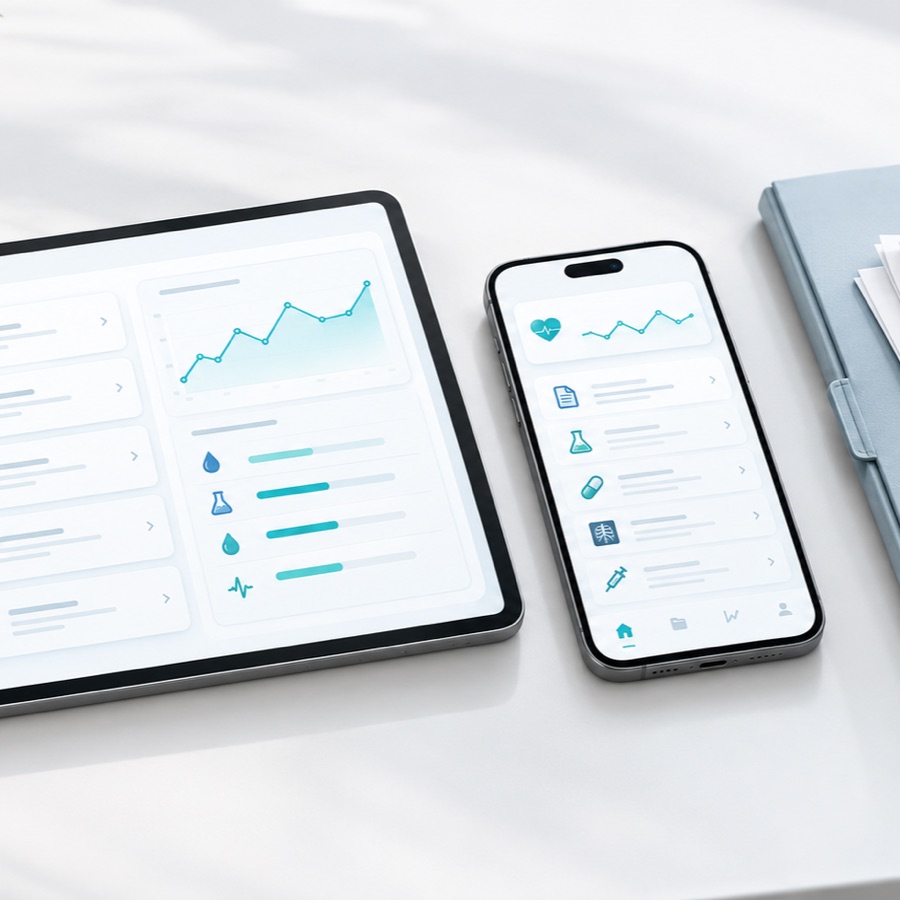
Most people have a medical record. Few have it with them. Lab results sit in a laboratory's portal, prescriptions in a pharmacy app, discharge letters in a cardboard folder, and vaccinations in a booklet nobody has seen in years. When it matters, in an emergency, with a new doctor, in another country, the information is not there. A digital medical records app fixes that: the record lives on your phone, under your control.
At a glance
| What it is | Your whole medical history, in one place, in a form that any system can read |
|---|---|
| What belongs in it | Conditions, medications, allergies, vaccines, results, letters and images, home measurements |
| Why keep it yourself | Portals cover one provider or one country; emergencies and new doctors need the whole picture |
| Standards | FHIR R4 for data, the International Patient Summary for the one-page version, EHDS for your rights |
| Building it | Request copies, add them as values not photos, keep it current after each visit |
| Safety | Encryption, access you control, an access log, export at any time |
A digital medical record solves exactly that: one place, yours, where your medical history is complete, organised and can be shown to whoever you choose. This guide explains what it is, what it should contain, how it differs from hospital systems and how to build it without drowning in detail.
Looking for the bigger picture? What is digital health explains the wider field, and taking your records abroad covers travel and moves.
What a digital medical record is
A digital medical record is a structured collection of information about your health, kept electronically and controlled by you: diagnoses, medications, allergies, lab results, vaccinations, documents, measurements. In the literature it is called a personal health record (PHR).
The important word is "controlled". The hospital that admitted you has a record about you. The laboratory that runs your tests has another. Your family doctor, another. Each is complete for its own episode and blind to the rest. Your digital record is the only one that can bring them all together, because the only person who walks through all those doors is you.
Personal record, electronic record, national record
Three terms are often mixed up and are worth separating:
- The electronic health record (EHR / EMR) is the internal system of a hospital or clinic. The doctors there use it. You get, at most, a printed summary or a PDF.
- The national electronic record is a registry run by the state, fed by providers in the public system. Germany has the elektronische Patientenakte (ePA), France Mon espace santé, Italy the Fascicolo Sanitario Elettronico, Romania the Dosarul Electronic de Sănătate (DES). They mostly contain what doctors in the public system report.
- The personal health record (PHR) is yours. It can include data from the first two, but also what they never see: tests done privately, symptoms noted at home, blood pressure measured in the morning, over-the-counter medicines, files from a clinic in another country.
The three do not exclude each other. A good personal record knows how to import from official systems and, when needed, send them back a summary. The first of the three has its own guide: what a personal health record (PHR) is, with examples, apps and templates. How to access your health records online lists the national portals country by country.
What belongs in it
Not everything at the same level of detail. There is a core every doctor wants in the first 30 seconds, and a layer of history that matters over time.
The core, for emergencies and first contact
- Identity and contacts: name, date of birth, blood group if you have it from a document, an emergency contact, your family doctor.
- Allergies and adverse reactions, with severity and what happened. A clearly noted penicillin allergy can change a decision in the emergency room.
- Active conditions: diabetes, hypertension, asthma, epilepsy, autoimmune disease, anything you are currently treating.
- The medications you take now, with dose and frequency, including supplements and contraceptives. Interactions are checked against the full list, not the one you remember.
- Implants and devices: pacemaker, prosthesis, stent, insulin pump.
- Vaccinations, with the date and, ideally, the batch.
This core is, almost literally, what the international standard calls the International Patient Summary (IPS): a short document designed for a doctor who has never seen you before, possibly in another country. More on it below.
The history, which matters over time
- Laboratory results, with the numeric values, units and reference ranges, not just the PDF. A glycated haemoglobin followed over five years tells a story a single value cannot.
- Imaging and reports: ultrasounds, X-rays, MRI, with the radiologist's conclusion.
- Admissions and procedures: when, where, why, with the discharge letter.
- Consultations: what the doctor said, what they recommended, what comes next.
- Your own measurements: blood pressure, pulse, weight, blood glucose, sleep, steps. Many come automatically from a phone or watch.
- Symptoms and wellbeing, noted when they occur. These are the most underrated data in medicine: a three-month headache diary is more useful to a neurologist than any description from memory.
- Family history: conditions of parents and siblings, where they matter for your own risk.
Why you should keep it, and not just the system
Four situations where your own record makes the difference:
The emergency. A doctor who sees you unconscious or confused needs allergies, medications and conditions within seconds. They cannot get them from your private laboratory, nor from a hospital in another region.
The new doctor. You move city, change family doctor, see a new specialist. Each starts from zero unless you bring the history. With an organised record, the first consultation picks up where the last one left off.
The second opinion. Any serious doctor wants to see the original results and imaging, not someone else's interpretation. If you have them, you ask. If not, you wait and repeat them.
Another country. National systems talk to each other only partially. An IPS summary on your phone, in a standard format, can be read in any European hospital that implements the standard, and more and more do.
There is a less visible reason too: your data keeps its value over time only if it is in a format you can take with you. A record you cannot export is not yours, however good it looks.
Formats and standards: what FHIR, IPS and EHDS mean
You do not need to know them to have a good record. You need to know them to choose well where you keep it.
- HL7 FHIR is the modern standard for medical data, used by hospitals, apps and authorities worldwide. Each piece of information (a test, a medication, an allergy) is a "resource" with a known structure that any compliant system understands the same way. If your record is stored as FHIR, it can be moved, read and extended by any compatible system. We have a separate guide on what FHIR is and why it matters to you.
- IPS (International Patient Summary) is a standardised summary, built from FHIR, with exactly the core described above. It is the format the European Union uses to exchange summaries between countries. Our guide to the IPS explains what it contains and how to get yours.
- EHDS (European Health Data Space) is the European regulation, in force since 2025, that gives you the right to access your medical data electronically, download it and transmit it to providers in any member state, in standard formats. Member states have several years to implement its provisions. Details in the guide on medical data in the EU.
The practical rule: choose a solution that keeps your data in a standard format and exports it completely, at any time. Everything else is convenience.
How to build it, step by step
Do not try to digitise 20 years of paper on the first evening. The order below gives the most benefit for the least effort.
Step 1: the core, in 15 minutes
Write down the allergies, active conditions, current medications with doses, implants and the vaccinations you know for certain. What you are not sure about, leave blank; a record with gaps is better than one with guesses. If your app can generate an emergency card or an IPS from this data, do it now.
Step 2: the last 12 months
Gather the lab results, medical letters and prescriptions from the past year. Most laboratories and clinics provide them as PDFs; some can export them in structured form. Enter lab values as numbers, not just pictures, at least for the ones you follow (glucose, cholesterol, TSH, blood count, whatever your doctor said matters).
Step 3: the continuous flow
Make it a habit: every new document goes into the record the day you receive it. Scan it with your phone, file it under the right person (you, your child, your parent), note what the doctor said in two lines. Two minutes at every consultation beat any weekend "catch-up" session.
Step 4: automatic data
If you wear a watch or use your phone's health app, connect them. Steps, heart rate, sleep and weight accumulate on their own and, over time, give context to your lab results. On iPhone the data goes through Apple Health, on Android through Health Connect; the guide on Apple Health and Health Connect explains what syncs and how.
Step 5: the old history, when you have time
Past procedures, admissions and important diagnoses are worth adding as events, with the year and place, even if you no longer have the documents. "Appendectomy, 2011, Sibiu County Hospital" is complete information for a doctor.
Safety and privacy
Under European law, health data is a special category (Article 9 of the GDPR). Anyone processing it has stricter obligations than for an e-mail address. When choosing where to keep your record, look at:
- Where the data is stored. Hosting in the European Union means the GDPR applies directly, without transfers to other jurisdictions.
- Who can see it. A doctor, clinic or app should see the record only with your explicit consent, for a limited period, revocable, and you should be able to see who read what.
- Export and deletion. You have the right to both. A serious solution exports everything, in a standard format, and deletes the account on request.
- No ads, no selling of data. If the service is "free" and you cannot see a clear revenue model, ask yourself what it lives on.
How Anpheros Daily helps
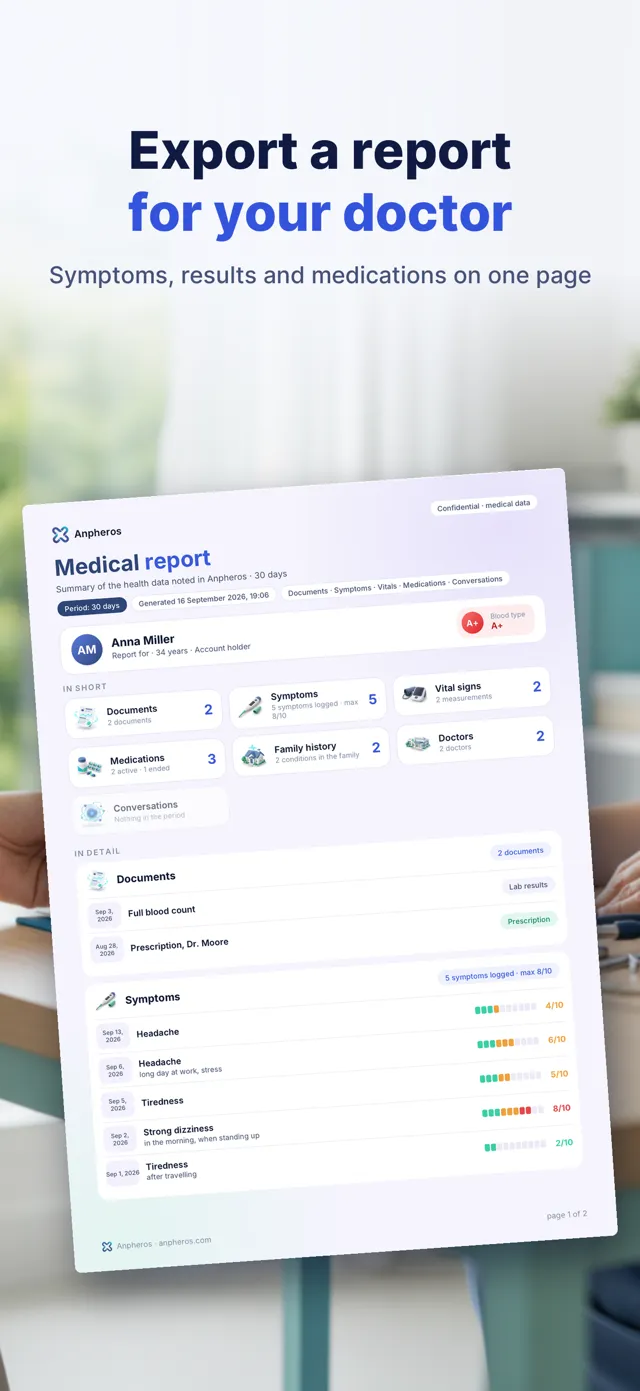
Anpheros Daily, a medical records app for patients, is built on exactly the principles above: your record is stored as HL7 FHIR R4 resources, in the European Union; symptoms, lab results, medications, documents and measurements live in one place, for you and your family; data from Apple Health and Health Connect flows in automatically; and clinics, laboratories or AI assistants reach the record only with your consent, logged and revocable. You can export at any time, including as an IPS. The Basic plan is free. The same app is a symptom tracker app and a medication tracker app: the daily side of the same record. If you are comparing apps, how to choose a medical records app lists the criteria that matter.
For the day-to-day part, the daily health tracker app keeps blood pressure, sleep, weight and steps on the same timeline, and the free at home eye test on your phone adds your visual acuity to the record.
It is not the only option and does not have to be. Any solution that follows the rules above is a good step. What matters is to start with the core, today.
Frequently asked questions
What is a digital health record?
Your health information kept electronically instead of on paper: conditions, medications, allergies, vaccinations, lab results, documents and measurements. The term covers both the record a hospital keeps about you and the one you keep yourself; this guide is about the second, the personal record you control.
What is the difference between a digital medical record and an electronic medical record (EMR)?
An electronic medical record (EMR or EHR) is the internal system of one hospital or clinic, written by its staff and complete only for what happened there. Your digital medical record is the personal one: you fill it from every provider and from home, you decide who sees it, and it goes with you when you change doctor or country.
When did medical records go digital?
Hospitals began replacing paper charts with electronic systems in the 1990s and 2000s; in the United States most hospitals had one by 2014, and in the European Union national records such as Germany's ePA and France's Mon espace santé followed in the 2020s. Records kept by patients themselves went digital later, with phone apps, and the EU's European Health Data Space is meant to connect the two from 2025 onwards.
What is a personal health record (PHR) app?
An app in which you keep your own medical record: conditions, medications, allergies, vaccinations, results and documents, together with your own measurements and symptoms. Anpheros Daily is a personal health record app; your record is stored in the HL7 FHIR format and you decide who sees it.
Is a digital medical record the same as my country's national electronic record?
No. The national record is run by the state and fed by providers in the public system. Your personal digital record is controlled by you and can also include what the national system never sees: private tests, home measurements, documents from other countries. Ideally the two complement each other.
Can I add lab results from 10 years ago?
Yes, and it is worth it. Old values give context to new ones. If you only have the paper, scan it and enter the important values manually; if you have the laboratory's PDF, some apps extract the values automatically.
What if I do not remember a diagnosis or a medication exactly?
Note what you know and mark what is uncertain. At the next consultation, ask your doctor and correct it. A record does not have to be perfect to be useful; it has to be honest.
Who is allowed to see my record?
Only those you give consent to. In a well-built system, consent is given to a specific person or institution, for a limited period, and can be withdrawn at any time; every access stays logged and visible to you.
How long does it take to set up?
The core, 15 minutes. The last year, an hour or two, depending on how many documents you have. The rest accumulates over time, two minutes at each consultation.
All your medical documents in one place you control
Keep your whole medical record in Anpheros Daily and share it with any clinic by link or QR code.
How it works in the app →Works in your browser · no app needed
Anpheros builds a medical record that the patient controls and can share with any clinic, on an HL7 FHIR R4 platform, based in the EU. These guides help you understand and organise your health; they do not replace your doctor.
About Anpheros → Anpheros
The more you log, the clearer your record
Your health history in one place, under your control.
- Symptom diaryPatterns show over time
- Emergency cardA QR code anyone can scan
- All your resultsLabs and reports together
- You decideWho sees what, and for how long
Free · Works in your browser · No card