Short answer: carry a one-page health summary (conditions, allergies, medication with generic names and doses), your key reports, and an emergency card in the language of the country, and keep a copy on your phone that works without internet. If you can, use the International Patient Summary format, which doctors in many countries can read. Share more of your record only when a doctor needs it, and only for as long as they need it.
At a glance
| Carry | A one-page summary, key reports, an emergency card in the local language |
|---|---|
| Format | The International Patient Summary, which doctors in many countries can read; a PDF as backup |
| Offline | A copy on the phone that opens without internet |
| Medicines | Generic names and doses; a prescription or a letter for controlled medicines |
| Sharing | Only what a doctor needs, only for as long as they need it |
| Moving abroad | Request full copies before you leave; find out how the new country's record works |
A foreign doctor, hospital or pharmacist will not have your history. What helps them is not a pile of papers but a short, clear summary in a standard form, with the original reports behind it if they ask.
What to carry
The minimum, for any trip:
- Your conditions and past operations, in one line each.
- Allergies and reactions, especially to medicines.
- Medications with the generic (active ingredient) name, dose and how often, because brand names differ by country.
- Blood group, if you know it.
- An emergency contact and your doctor's contact.
- Vaccinations, if the destination asks for them.
If you have a long-term condition or are moving abroad, add:
- The latest reports that matter: recent blood tests, a cardiology or kidney report, a discharge letter.
- Imaging reports, and the images themselves if you are starting treatment abroad (see how to get your CT or MRI images).
- A doctor's letter in English for conditions or devices (an insulin pump, a pacemaker), and for medicines that are controlled in some countries.
In which format
Three formats cover almost every situation, and it is worth having at least the first two.
- A printed one-page card or summary, in English and ideally the local language. Paper works when the phone is lost, locked or flat. The travel medical card tool prints one with the labels translated into ten languages.
- A digital copy on your phone that works offline: a PDF saved to the phone, not a link that needs signal.
- A standard health summary. The International Patient Summary (IPS) is an international format for exactly this: conditions, allergies, medication and more, in a structure other countries' systems can read. It is being adopted in Europe and beyond, though how much a given hospital uses it still varies, so keep the PDF as well.
For sharing with a doctor you can reach by link or QR code, a SMART Health Link opens your summary with an expiry date and an optional passcode, and you can cancel it afterwards.
Do not rely on a single place
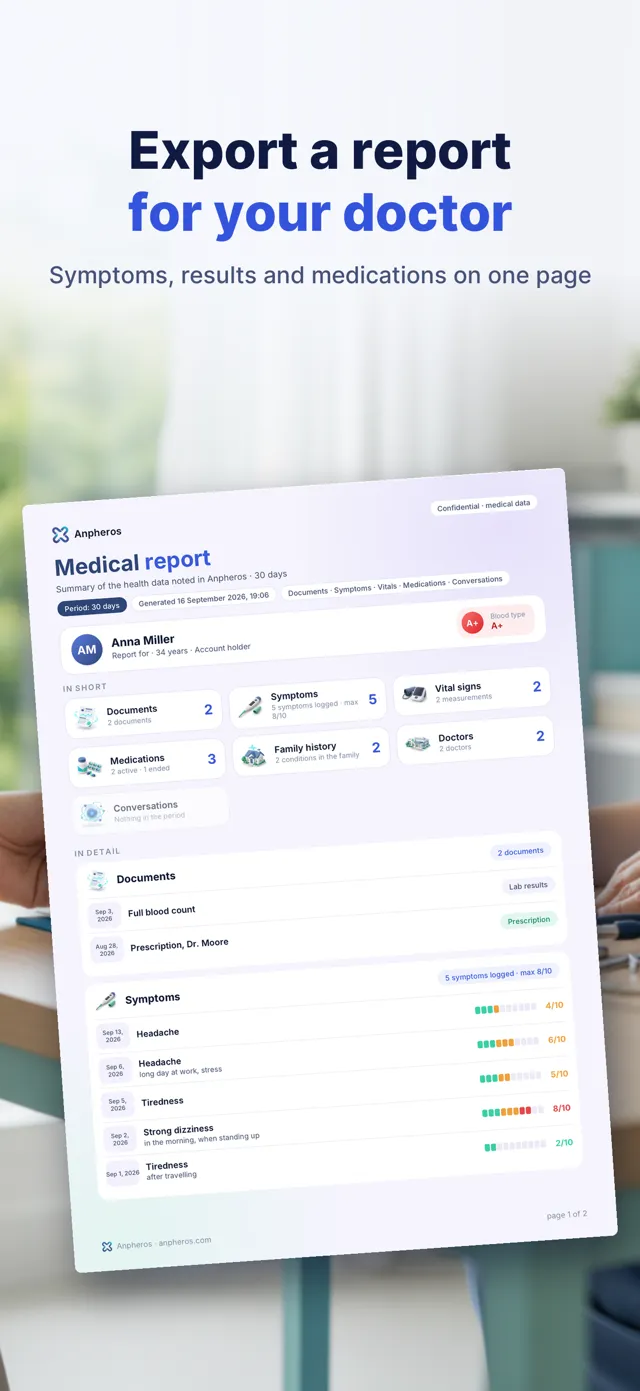
Do not put all your information in one app, one cloud folder or one device. Keep the card in your wallet, the PDF on your phone, and a copy somewhere you can reach from any computer. If you use a personal health record such as Anpheros Daily, you can export the summary and the emergency card in advance and carry both.
Language and translation
Doctors in many countries read English medical terms, but not all do. Use the official name of a condition in English, the generic names of medicines, and avoid abbreviations specific to your own country. A card with labels in the local language ("Allergies", "Medications") helps the person reading it find what they need quickly. For long documents, a certified translation is only needed for formal procedures such as insurance claims or immigration; for care, a clear English summary is usually enough.
Prescriptions and medicines
Carry medicines in their original packaging, with the pharmacy label, and a doctor's letter for anything controlled or injectable, as rules differ by country and some medicines are restricted. Within the EU there is a system for using an electronic prescription in another country, but it does not yet work everywhere or for every medicine, so check before you rely on it. Our guide to e-prescriptions across EU borders explains what works today.
If you move abroad, not only travel
When you move, ask your current doctors for a copy of your records before you leave, because getting them from abroad is slower. Use the medical records request letter for the right wording in your country, and see how to transfer your medical records to a new doctor for the steps in the EU, UK and US.
Privacy while you carry it
A health summary is sensitive. Protect the phone with a passcode, share a summary with a link that expires rather than sending a file to a stranger's email, and ask a clinic to confirm how it will store what you give it. In the EU, you can ask any provider for a copy of your data, which is useful before a move. Do not post your records or summary on social media.
Frequently asked questions
Can I take my health records with me when I travel abroad?
Yes. Carry a one-page summary (conditions, allergies, medication with generic names), your key reports and an emergency card, in print and on your phone. Many health systems read the International Patient Summary format, and a copy that works offline avoids dependence on signal.
What medical documents should I carry when travelling?
The minimum is conditions, allergies, medications with generic names and doses, blood group, an emergency contact and, if relevant, vaccinations. For a long-term condition add recent reports and a doctor's letter in English.
In what language should my medical records be?
English is the most widely understood, and the local language is a help for the emergency card. Use official English names for conditions and generic names for medicines. Certified translations are needed only for formal procedures like insurance claims.
What is the International Patient Summary and do I need one?
It is a standard format for a short health summary that systems in different countries can read. You do not need one for a short holiday, but it is useful if you live with a chronic condition or move abroad.
Can a foreign doctor access my records online?
Only if you give access. You can share a summary by a time-limited link or QR code, or show it on your phone. Whether a given hospital can open a standard summary varies, so also carry a PDF.
How do I carry my medical records offline?
Save a PDF summary to your phone, so it opens without signal, and keep a printed card in your wallet. A link that needs internet may not work when you need it.
Do I need my medication list translated?
Not usually. Use generic names, doses and times, which pharmacists everywhere understand, and keep medicines in their original packaging with the label.
Can my e-prescription be used in another country?
Within the EU there is a system for it, but it is not available in every country or for every medicine yet. Ask your pharmacy before you travel and carry a doctor's letter.
MyHealth@EU or my own copy: which one do I need?
Both, because they do different jobs. MyHealth@EU lets a doctor or pharmacy in another participating EU country retrieve your national patient summary or e-prescription at the point of care, with your consent; you carry nothing, but it works only between countries that have gone live, for the categories your country has connected, and not in the UK or Switzerland. Your own copy (a summary, your reports and a medication list in an app on your phone) works anywhere, offline, with your full history and with what your national record does not hold. Keep your own copy and treat MyHealth@EU as a bonus where it exists; details in our guide on MyHealth@EU and the cross-border patient summary.
How do I get my records before moving to another country?
Ask each doctor and hospital for a copy, use a request letter with the right legal wording for your country, and allow several weeks. Getting records from abroad after you move is slower.
This guide is general information, not medical or legal advice. Rules on medicines and records differ by country; check with your doctor and the destination's authorities.
Try it in Anpheros Daily
Keep your whole medical record in Anpheros Daily and share it with any clinic by link or QR code.
How it works in the app →
Anpheros builds a medical record that the patient controls and can share with any clinic, on an HL7 FHIR R4 platform, based in the EU. These guides help you understand and organise your health; they do not replace your doctor.
About Anpheros → Anpheros
The more you log, the clearer your record
Your health history in one place, under your control.
Free · Works in your browser · No card