Short answer: The three terms describe who keeps the record and how far it travels. An EMR (electronic medical record) is the digital chart of one practice or hospital. An EHR (electronic health record) is designed to share a person's information across organisations, for example between a GP, a hospital and a lab. A PHR (personal health record) is kept and controlled by the patient, who decides what goes in and who sees it.

At a glance
| EMR | The digital chart of one practice or hospital |
|---|---|
| EHR | Designed to share your information across organisations |
| PHR | Kept and controlled by you |
| How data moves | Through standards such as FHIR and the International Patient Summary, or by copies you carry |
| Who controls what | The provider controls the EMR and EHR; you control the PHR and who sees it |
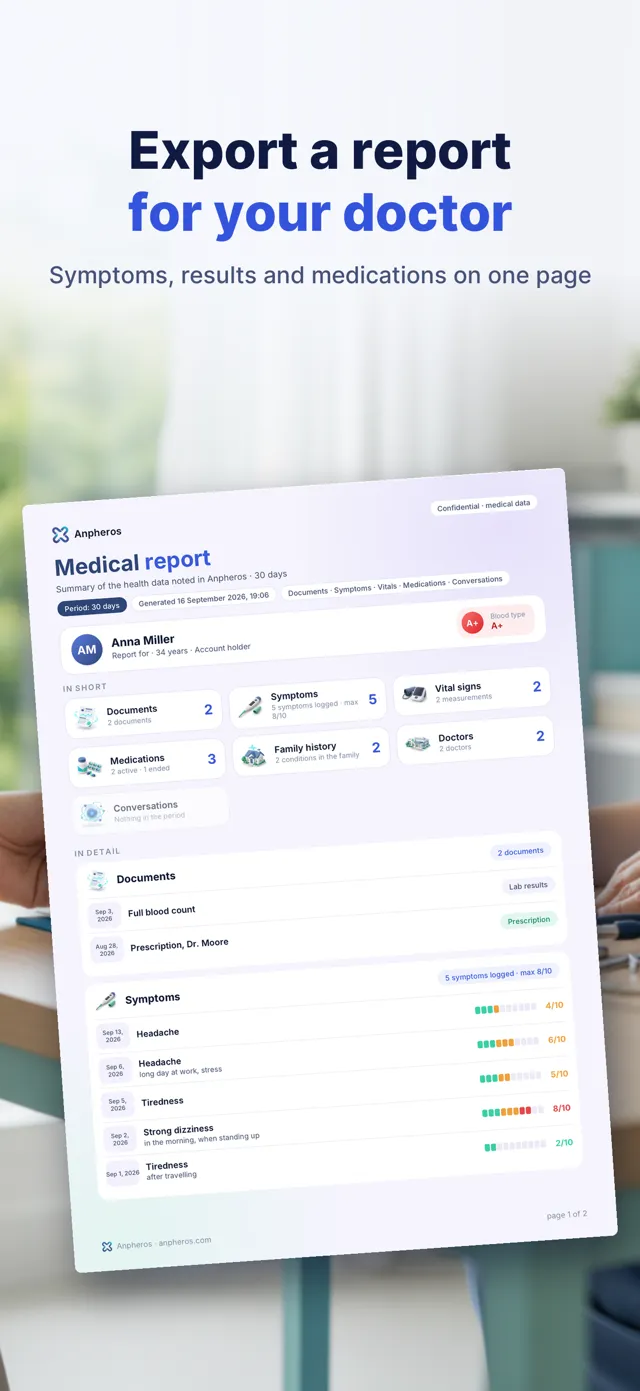
| In Anpheros | A PHR that reads and writes FHIR, so clinics' systems can use it |
What each one is for
- EMR: replaces the paper chart inside one organisation: notes, orders, results, prescriptions. It is built for the clinicians who work there.
- EHR: the same information, built to move with the patient between providers, often through national or regional networks.
- PHR: a record the person keeps: copies of results and letters, medications, symptoms, measurements from devices, for themselves and their family. It can include data from many EMRs and EHRs, plus what the patient adds.
In everyday speech EMR and EHR are often used interchangeably; the distinction matters when you ask who can read the data and whether it can leave the organisation.
How data moves between them
Standards make the difference between a record you can move and one you cannot. HL7 FHIR lets an EHR expose data through an API; the International Patient Summary packs the essentials into one standard document; in Europe the EHDS regulation gives patients a right to electronic access and portability. Our guides on the personal health record and transferring medical records go further.
In Anpheros
Anpheros Daily is a PHR: each family member has a record you control, stored as HL7 FHIR R4, which you can export or share with a clinic for a period you choose; Anpheros Platform lets clinics' EHRs and other apps read it with your consent. See the medical records app and, for developers, the EHR API guide.
Related pages
Sources
Frequently asked questions
What is the difference between an EMR and an EHR?
An EMR is one organisation's digital chart; an EHR is built to share information across organisations. In practice the terms often overlap.
Who owns a personal health record?
The patient keeps and controls it, deciding what is in it and who can see it.
Can I get data from my hospital's EHR into a PHR?
Increasingly yes: through patient portals, FHIR APIs, downloads of the patient summary or by scanning letters and results.
Is a PHR a medical device?
A PHR that only records and organises information is generally not; software that diagnoses or recommends treatment can be. See our page on whether a health app is a medical device.
Try it in Anpheros Daily
Keep your whole medical record in Anpheros Daily and share it with any clinic by link or QR code.
How it works in the app →
Anpheros builds a medical record that the patient controls and can share with any clinic, on an HL7 FHIR R4 platform, based in the EU. These guides help you understand and organise your health; they do not replace your doctor.
About Anpheros → Anpheros
The more you log, the clearer your record
Your health history in one place, under your control.
Free · Works in your browser · No card