
How long can you stand on one leg? A balance test you can do now
In short: the single-leg stance test times how long you can stand on one leg, arms crossed, first with your eyes open and then closed. Healthy adults under 40 often reach the 45-second limit with their eyes open; the average falls with age, to under half a minute in the 60s. This page times you, keeps your best try and shows the average for your age group from a published study of healthy adults. It is a simple check of balance, not a diagnosis.
Balance is quiet work. Your inner ear, your eyes, the nerves in your feet and the muscles around your ankles and hips agree, many times a second, on where you are and how to stay upright. Standing on one leg takes away part of that support, and closing your eyes takes away more, so the test shows how well the rest copes. It is one of the checks physiotherapists and doctors use most, because it is quick and needs nothing.
Timed for you
Tap Start and Stop; the page times you to a tenth of a second and stops by itself at 45 seconds.
Eyes closed, by sound
A beep tells you when to close your eyes and when the time is up, so you never need to look at the screen.

Compared with your age
Your best time next to the average for healthy adults your age.
How to do the test
- Stand barefoot on a firm floor, next to a wall, a kitchen counter or a sturdy chair you can grab if you wobble.
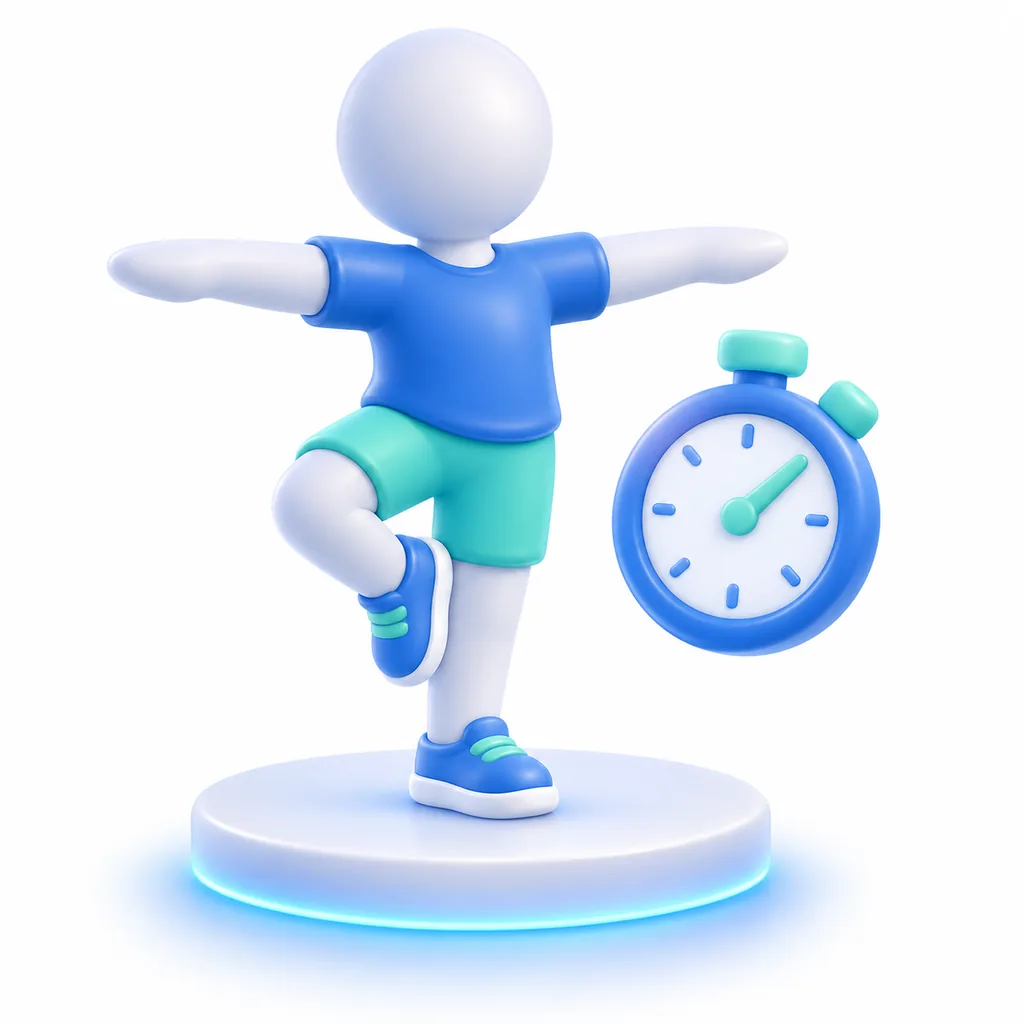
- Cross your arms over your chest and lift one foot so it does not touch your standing leg. Use whichever leg feels natural.
- Tap Start and keep your eyes on a point in front of you.
- Tap Stop as soon as your raised foot touches the floor or your other leg, your standing foot shifts, or your arms uncross. The test stops by itself at 45 seconds.
- Repeat with your eyes closed. Tap Start, close your eyes at the beep, and tap anywhere on the large button when you put your foot down.
You can take up to two tries for each part; the best one counts. Skip the eyes-closed part if you have fallen recently, feel dizzy or are unsteady.
Average times by age
| Age | Eyes open, average | Eyes closed, average |
|---|---|---|
| 18–39 | about 43 s | about 9 s |
| 40–49 | about 40 s | about 7 s |
| 50–59 | about 37 s | about 5 s |
| 60–69 | about 27 s | about 3 s |
| 70–79 | about 15 s | about 2 s |
| 80 and over | about 6 s | about 1.3 s |
The figures are rounded averages from a study of healthy adults with a 45-second limit (Springer and colleagues, Journal of Geriatric Physical Therapy, 2007). People vary a lot; a single result says little on its own, and your own trend over months says more.
What the result can and cannot tell you
A short time does not tell you why. Tiredness, shoes, a soft floor, a sore ankle or simply a first try all shorten it. What the test does well is give you a number to watch: if you practise, it usually gets longer within weeks. Standing on one leg while you brush your teeth or wait for the kettle is the classic exercise.
Studies have linked not managing 10 seconds on one leg in middle and older age with poorer health in the following years, and a short one-leg stance in older people with more injurious falls. If you are over 50 and cannot stand 10 seconds with your eyes open, or you have fallen, feel unsteady or have dizzy spells, tell your doctor. Dizziness has many causes, from the inner ear to blood pressure and medicines; how balance works explains the main ones.
Sources
- Springer BA, et al. Normative values for the unipedal stance test with eyes open and closed. Journal of Geriatric Physical Therapy 2007;30(1):8–15. doi:10.1519/00139143-200704000-00003
- Araujo CG, et al. Successful 10-second one-legged stance performance predicts survival in middle-aged and older individuals. British Journal of Sports Medicine 2022;56(17):975–980. doi:10.1136/bjsports-2021-105360
- Vellas BJ, et al. One-leg balance is an important predictor of injurious falls in older persons. Journal of the American Geriatrics Society 1997;45(6):735–738. doi:10.1111/j.1532-5415.1997.tb01479.x
Frequently asked questions
How long should I be able to stand on one leg?
Most healthy adults under 50 manage 30 to 45 seconds with their eyes open. The average drops with age: about 27 seconds in the 60s and about 15 in the 70s. With eyes closed, a few seconds is common at any age over 50.
Why is it so much harder with my eyes closed?
Your eyes do a large part of the balancing work. Without them, your body relies on the inner ear and on the sense of position from your feet and joints, which is why times drop sharply for everyone.
Which leg should I stand on?
Either. If you want to compare over time, use the same leg each time, or test both and note them separately.
Can I improve my balance?
Yes, at any age. Regular practice on one leg, tai chi, and strength exercises for the legs and hips all improve balance; a physiotherapist can give you a programme if you have fallen or feel unsteady.
Is this test safe?
Do it next to something you can hold, on a firm floor, without shoes. Skip the eyes-closed part, or have someone next to you, if you have fallen recently, feel dizzy or are unsteady.